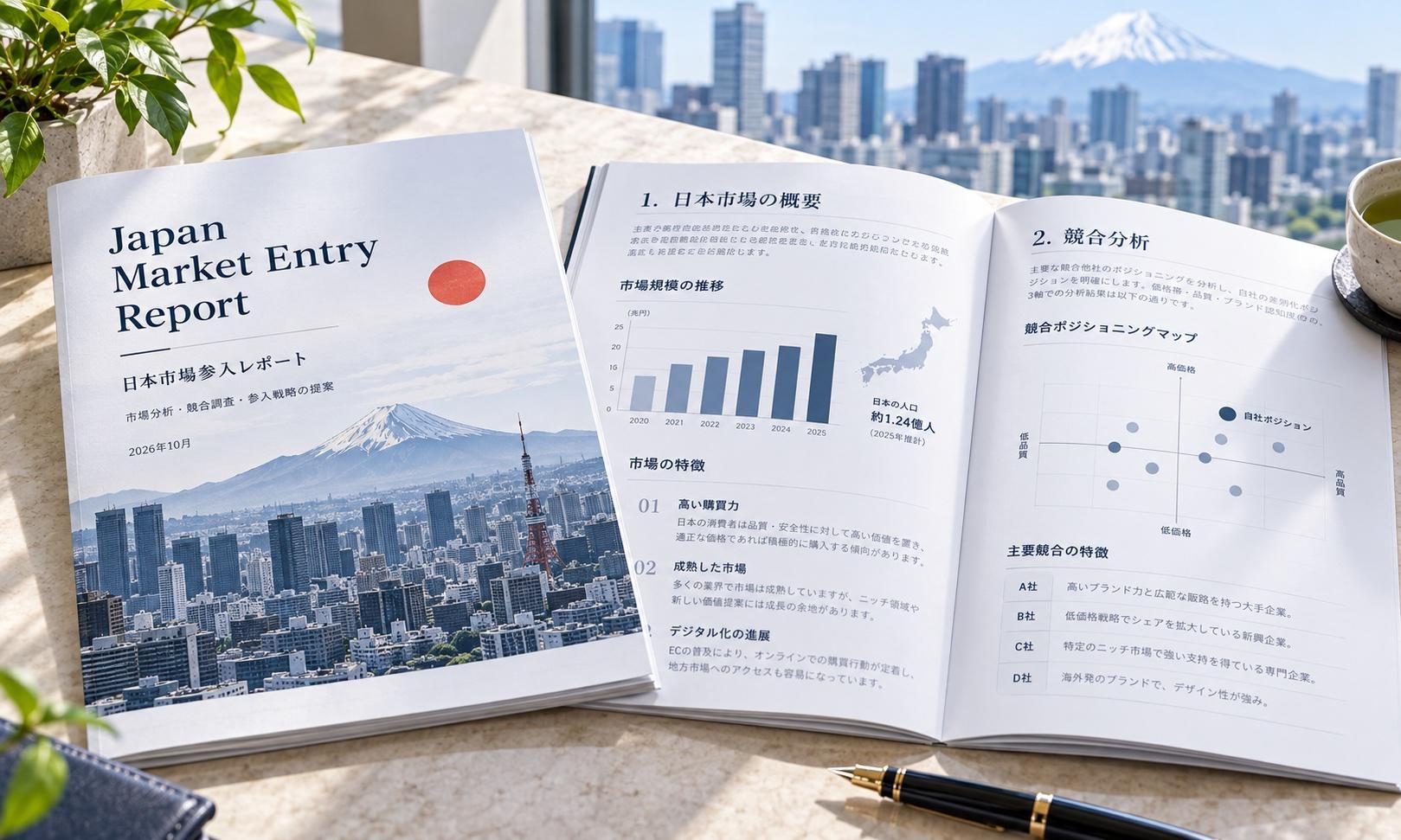
Market Entry Report
Everything you need to decide on Japan, in one document.
Demand, competitors, rules, costs, routes and channels — researched for your company, in four parts and seventeen chapters, in English.
$500Deducted from your first invoice when you go ahead.
- Nothing to pay today
- Written in English
- Yours to keep
01Why it comes first
Every engagement starts here.
Before we build, market or sell anything, the report decides what is worth doing — and what isn't.
Required for every engagement
It decides the plan
What to build, in what form and in what order — so no budget goes on the wrong thing first.
It can say “don't enter”
Because it is paid, its verdict is allowed to be “not yet”, “don't enter” or “do these two things yourself”.
It stays yours
Use it with us, with another vendor, or entirely in-house. Nothing in it depends on hiring us.
02The questions it answers
The questions you're asking. Each one has a chapter.
We don't know if there's real demand for us in Japan.
Answered in Part I · ch. 01
We have a translated site — and nothing is happening.
Answered in Part III · ch. 10–11
We can't tell which regulations apply to our category.
Answered in Part II · ch. 06
We don't know what entering would actually cost, in total.
Answered in Part IV · ch. 16
Direct, marketplace, or distributor — we can't judge from here.
Answered in Part IV · ch. 13
Everyone says Japan is different. Nobody says how, for us.
Answered in All four parts
03What you get
Six things you hold at the end.
A clear, practical view of your opportunity in Japan, in one document.
The opportunity, sized
What demand actually exists for your category — measured from public and marketplace data, sources cited — who holds it today, what they charge, and what buyers see when they search you right now.
Part I · ch. 01–05
The rules, in plain English
The laws, licences and certifications that govern your category, which of your current claims would cross them — sentence by sentence — and whether your name itself survives translation.
Part II · ch. 06 · 09
What you need locally — and don't
Entity, inventory, Japanese-speaking staff, payment rails: what Japan genuinely requires of your category, and what can run from home with the right tooling.
Part II · ch. 07–08
Your position, measured
Readiness scored 0–30 across 15 conditions verified against your live site, the trust layer currently disqualifying you named — and every existing asset sorted: translate, rebuild, or leave behind.
Part III · ch. 10–12
- The heaviest part
The whole plan, costed
Every route to market and every channel analysed one by one — strategy and cost against each — then one recommended combination, phased, budgeted and timed, with the risks ranked. The heaviest part of the report.
Part IV · ch. 13–17
A document you keep
All seventeen chapters in one English document, built to be forwarded and circulated internally. Yours permanently — usable with us, with another vendor, or entirely in-house.
All four parts
04Inside the report
Four parts, in the order you'd ask them.
From “Is Japan even a market for us?” to “So how do we actually enter?”
Part I第一部
The opportunity
“Is Japan even a market for us?”
Before anything else: does demand exist, who holds it, and what does your price look like here — measured from the Japanese side, sources cited.
- 01Market opportunity
- 02The Japanese buyer
- 03What buyers see today
- 04The competitive field
- 05Price positioning
Research is systematised end to end; the score and regulation chapters carry a human sign-off; every figure is sourced.
See all seventeen chapters
Part I · The opportunity
- 01Market opportunitySize and growth signals for your category, from public and marketplace data — a cited number, not a hunch.
- 02The Japanese buyerWho buys, and how the decision actually travels — the B2B approval chain, or the B2C research ritual of reviews and comparison sites.
- 03What buyers see todayAnnotated screenshots of what a Japanese buyer finds when they search your category — and your brand — right now. Including anything negative.
- 04The competitive fieldWho you'd really face, including the domestic players you've never heard of — with a close teardown of the category leader.
- 05Price positioningWhat the market charges, how prices are expected to look here, and where your global price lands when it arrives unchanged.
Part II · The rules
- 06Regulation, licences & claimsThe laws that govern your category, the certifications and import requirements that apply — and which of your current claims would cross them.
- 07Commercial requirementsThe payment methods, invoicing cycles and support-hour expectations your operation must meet to be taken seriously.
- 08What you need locally — and don'tEntity, inventory, Japanese-speaking staff: what your category genuinely requires in Japan, and what can run from home with the right tooling.
- 09Name & brand checkHow your name renders in Japanese, unfortunate homophones, domain and SNS availability — and a preliminary trademark screen.
Part III · Where you stand
- 10Readiness scoreFifteen conditions across five areas, scored 0–2 each — verified against your actual site and listings, not just your answers.
- 11Trust-layer gap analysisAll seven layers of trust, assessed one by one — and the single layer currently disqualifying you, named.
- 12Asset triageEverything you already have, sorted three ways: translate as-is, rebuild for Japan, or leave behind — nothing made from scratch that doesn't need to be.
Part IV · The plan
- 13Routes to market — one by oneDirect e-commerce, marketplaces, distributors, direct sales — each candidate route for your category analysed on its own: how you'd play it, what it demands, what it costs to open and to run, and how well it fits you.
- 14Channels — one by oneSearch, LINE, the comparison sites, advertising, trade shows — each channel's role for your category, how it's fought, what it costs, and where your competitors already are.
- 15The recommended combinationWhich routes and channels, in which order — a recommendation with the reasoning shown, and the items not to spend on yet struck out with the reason in writing.
- 16Costs & timeline, per phaseEverything above consolidated into a phased budget — a realistic figure and timeframe for each phase, one-time and running costs separated.
- 17Risk registerThe ways companies like yours fail here, ranked — each with the mitigation written next to it.
05What it costs elsewhere
The same questions, priced elsewhere.
Published prices for comparable work from Japan-entry consultancies and research firms.
- A single-topic studyMarket sizing alone, or a regulatory assessment alone — one chapter's worth$1,300 – $6,700
- Japan-entry validation packageOpportunity, competitors, regulatory overview, pricing feasibility — roughly Parts I–IIfrom $10,000
- Custom study, traditional firm4–12 weeks; studies adding primary surveys run higher still$15,000 – $50,000
- This reportAll four parts, seventeen chapters — deducted from your first invoice$500
Why so much less? The framework is already built and published, and we earn on the work that follows — not on the report.
06How it works
Free until the hearing ends.
Two decisions on this line, and both are yours.
- Free1
Apply
The short form below — who you are, what you're bringing to Japan, and roughly when. Two minutes.
- Free2
The hearing sheet
A structured questionnaire by email about your business, product and current Japan footprint. It branches, so you only answer what applies.
- $5003
The $500 invoice
With the hearing complete, we invoice the $500. Nothing has been billed before this point.
- $5004
The report arrives
Analysis, verification, and a written document built to be circulated internally — the consulting, delivered. Yours to keep.
- Free5
The proposal
If the report says go, we turn its plan into a scoped, priced proposal for the first phase. Reading it costs nothing — and so does saying no.
- −$500 credit6
Kick-off
You approve, the work starts — and the $500 comes off that first invoice. Stop here instead, and the report stays yours.
07FAQ
Before you apply.
Isn't this just a sales pitch dressed as a report?
That's exactly the model we're avoiding. A free audit earns its keep by concluding you should hire the auditor. This one is paid, flat, and deducted later — so the verdict is allowed to be “don't enter,” “not yet,” or “do these two things yourself and skip the rest.” Reports we've written have said all three.
What do you need from us?
The hearing sheet — a structured questionnaire about your business, product and current Japan footprint. It branches based on your answers, so you skip everything that doesn't apply. No meetings are required, though we're happy to clarify questions by email.
Can I circulate it internally?
It's designed for exactly that. In Japanese B2B, decisions travel through written internal approval — and your own company works the same way. The report is written in English, structured so a CFO who has never thought about Japan can follow the argument, and it stays yours permanently.
What happens after the report?
Three honest options. Do nothing — you're out $500 and own a map. Take it to another vendor — everything in it works without us. Or proceed with us — then the $500 comes off your first invoice, and the report becomes the project's shared reference.
Who writes it?
The same people who publish the research on this site. The scorecard and the seven-layer model in the report are the frameworks behind our Insights — applied to your company specifically, with the evidence attached. Nothing in the method is a black box.
08Apply
Apply for the report.
Two minutes. Nothing to pay today — applying and the hearing are free.
- 1ApplyFree
- 2HearingFree
- 3$500 invoicedAfter the hearing
Prefer to pay now? Pay the $500 online — we still hold the hearing first.
Prefer email? contact@jinmarketing.jp